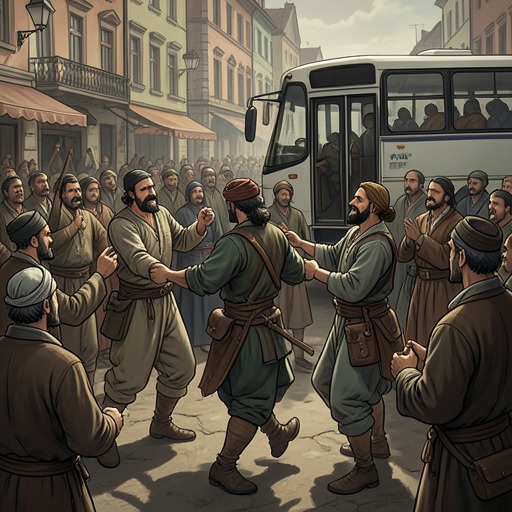
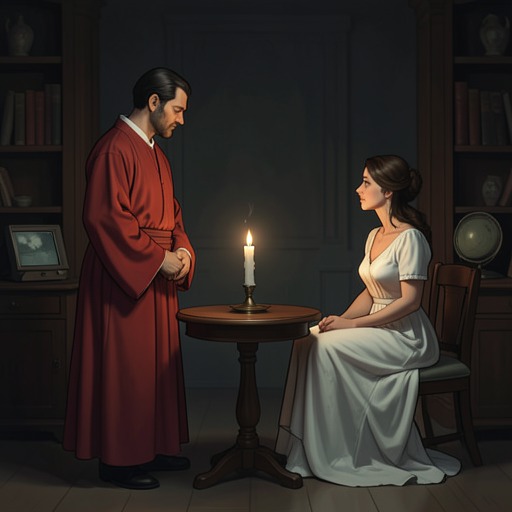
Ayemenem temple Kathakali performance
The God of Small ThingsThe Ayemenem temple Kathakali performance is a night-long retelling of epic vows and revenge that becomes, for Rahel and Estha, a charged encounter with their own past. Seated apart in the temple hall, they recognize each other through the story being performed; when Bhima’s ritualized violence gives way to remembered real violence, the boundary between theatrical myth and the twins’ experience breaks down.
Setting and Structure
The performance unfolds in the temple’s kuthambalam, with the twins seated against separate pillars, the breadth of the hall between them. The staging moves from one episode into another: Karna Shabadam, or Karna’s Oath, leads into Duryodhana Vadbam, the Death of Duryodhana and his brother Dushasana. The sequence carries the night toward dawn, when the performance’s mythic violence becomes central to the twins’ recognition of what they have seen before.
The Kathakali Men’s performance belongs to a world that is at once ritual and work. Elsewhere, the performers dance for visitors at the Heart of Darkness, collect their fee, and later stop at the Ayemenem Temple to dance and ask pardon of the gods. The temple scene thus places a sacred appeal beside a performance that is also labor: the same bodies inhabit roles for spectators and enact a ritual of apology.
Karna’s Oath and the Twins’ Recognition
Rahel watches Karna praying on the banks of the Ganga, a figure presented through a chain of identities: he is sheathed in light, the son of Surya, the abandoned child, the generous man, and a revered warrior. In the later episode, Karna promises Kunti that she will always have five sons. He will not harm Yudhishtra, Bhima, Nakula, or Sahadeva, but he refuses to make a promise about Arjuna: one of them will kill the other. The oath binds a mother and a son while preserving the prospect of fratricidal death.
The epic’s mother-and-son story makes the performance a shared medium for the twins. Rahel does not turn when the air alters, but knows Estha has arrived; his presence produces an inward glow, and she understands him as there with her. He sits at a distant pillar. They remain physically separated across the kuthambalam, yet joined by the story and by the memory of another mother. The performance does not reunite them through conversation: recognition comes first as a change in the air and as a silent, inward certainty.
Bhima’s Revenge and Theatrical Violence
The second episode turns the oath’s restrained promise into an extended act of vengeance. Dushasana had tried to undress Draupadi publicly after the Kauravas won her in a game of dice. She vows not to tie up her hair until it has been washed in his blood, and Bhima swears to avenge her honor. The performance places this violence within a battle already strewn with corpses, but first lets the opponents fence, trade insults, and recount their wrongs for an hour.
When the brass lamp begins to flicker, Bhima and Dushasana call a truce: Bhima pours oil while Dushasana cleans the charred wick. They then resume their fight, carrying it beyond the kuthambalam and around the temple compound with papier-mâché maces. Their pursuit circles a sleeping elephant; Dushasana shifts from bravado to cringing, while Bhima toys with him. Both are stoned, and the performance’s stylized bodies and props coexist with a mounting brutality.
Near four in the morning, Bhima clubs Dushasana down and continues striking the dying body until it is still. He then tears it open, drinks its blood, and goes to bathe Draupadi’s hair in it. The act fulfills the vow, but its excess exceeds the simple completion of revenge: Bhima continues killing after Dushasana is dead, and murder does not dispel the rage. By early morning, Estha and Rahel have watched the vow become a scene of bodily destruction.
The Story’s Break into Memory
The twins recognize something in Bhima’s frenzy beyond the performance. The scene is explicitly not merely theatrical to them: they have seen the work of madness before, on another morning and another stage, in a different kind of frenzy marked by millipedes on the soles of shoes. The remembered violence is not narrated here in full, but the comparison connects the epic’s extravagant spectacle with a brutality the twins know from their own lives. Their recognition depends on the contrast between the performance’s elaborate, drawn-out excess and the remembered violence’s savage economy.
The narrative describes them as frozen, quiet and empty, like two eggs that have not grown horns. Still separated by the width of the kuthambalam, they are trapped in a story that both is and is not theirs. What began with the semblance of structure and order has bolted into anarchy. The performance therefore does not offer the twins a safe distance from violence: its story gives their experience a shape, but that same story opens into the disorder and trauma already present in their past.
Dawn and the Return to Ordinary Life
The performance ends in a morning that refuses a clean separation between sacred story and daily life. Kochu Thomban wakes and carefully cracks open his morning coconut. The Kathakali Men remove their makeup and go home to beat their wives. The transformation from divine and heroic roles to ordinary men does not make the violence disappear; it reveals violence continuing beyond the stage, after the painted faces are gone.
For Rahel and Estha, the performance’s decisive consequence is not resolution but recognition. They sit silently, apart yet joined by the narrative and by shared memory. Karna’s promise to Kunti has made the mother’s place in the epic newly present between them, while Bhima’s revenge has exposed how readily a story of justice can become an image of uncontained brutality. The twins leave the scene without escaping the history it has stirred: the performance gives form to their connection, but neither its ritual setting nor its ending restores what violence has taken.